Design your whole system with full IDE support.
ARCitect 1.1 brings type definitions and validated autocomplete to your spec, lets you keep building with the agent, and makes every change reviewable — for projects up to 50 endpoints.
Spec editing with full IDE support
System design used to mean editing a document by hand — a Google Doc, a Notion page, whatever your team kept it in. These days you might point an agent at it instead, which is faster, but you land in the same place: a wall of barely-formatted Markdown you scroll through, search, and lose your place in. It’s frustrating, and it’s error-prone.
Your highest-leverage decisions happen in your lowest-powered tooling.
Which makes no sense. When you write code, your IDE knows your types. It autocompletes. It catches the mistake before you’ve finished typing it. The system those decisions define shouldn’t get worse tooling than the code built from it.
That’s the gap 1.1 closes. ARCitect reads through your documents, extracts the key entities, and brings that same editor intelligence to your spec. It’s what makes ARCitect an agentic IDE for writing specs, rather than a document editor with an AI bolted on.
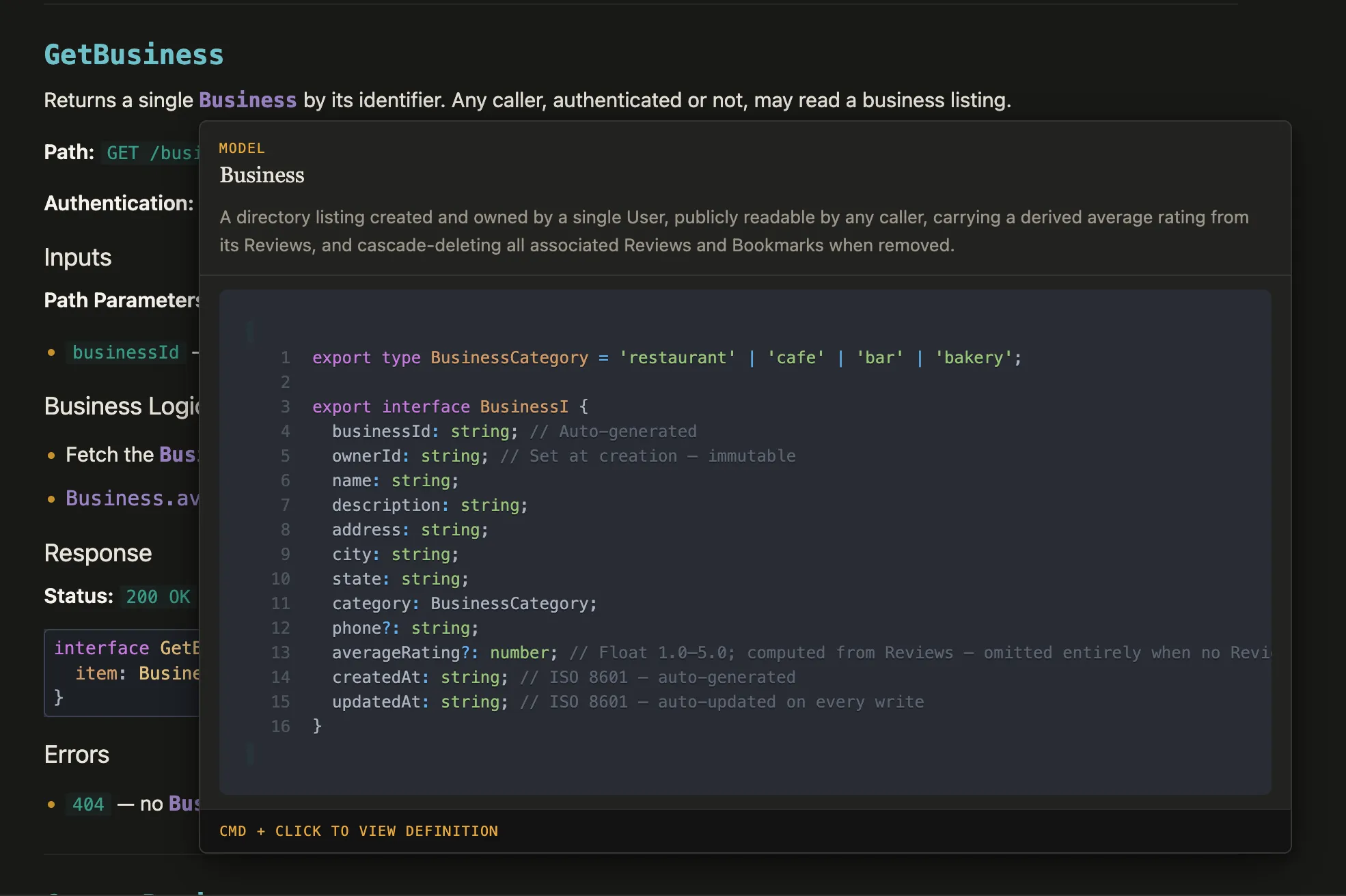
Type definitions
Hover over a Resource name and its type definition appears inline — the fields, their types, the whole shape — without scrolling off to find where you defined it. The structure you used to carry around in your head is surfaced right where you’re working.
Autocomplete
Start typing a property and you get validated autocomplete scoped to that Resource: only the fields that exist, with their real types. Fewer typos, fewer invented fields, fewer trips back to check what a Resource exposes.
Make changes with the agent — and review every one
Change Requests is really two features working together.
Keep building with the agent
If ARCitect’s agent drafted the first version of your document, you shouldn’t have to drop it the moment something needs to change. 1.1 lets you keep working with the agent to revise the project — describe what you want different, and it makes the change across the document, wherever it needs to reach.
Review every change
Here’s the part we care about most. The thing that separates high-performing software teams isn’t raw speed — it’s context management. Knowing exactly what’s changing, and what it touches.
That matters because the blast radius of an unintended change runs from “nobody noticed” to “we built the wrong system.” A single sentence can quietly swing scope, cost, implementation, and timeline all at once. Agents make changes fast, but speed without review is how a small ask turns into a rewrite you never approved.
So before anything lands, the agent confirms every edit tied to your request is present — nothing half-done, nothing missed — then hands you the result as a code review. Approve what’s right. Edit what’s close. Reject what isn’t. Change by change.
You get the leverage of an agent making changes with the control of a human reviewing them. That’s what makes ARCitect something you keep building in, not a one-shot generator you have to second-guess.
Room for larger systems
ARCitect now supports larger projects, with systems of up to 50 endpoints. If you’ve been splitting a system to stay under previous limits, you can keep more of it in one place. Alongside the scope increase, 1.1 includes workflow stability improvements under the hood.
A sharper system designer
We’ve continued training and refining the ARCitect agent to improve its system design capabilities. This is ongoing work rather than a single switch, and it shows up across everything above: the agent understands intent more reliably and produces cleaner, more correct results.
Start writing specs
that ship systems.
ARCitect is open to a limited beta cohort. We're prioritizing teams that own real APIs on AWS and founders building production-grade prototypes.
What you get- Early access to ARCitect and the full spec-as-source pipeline
- First access to Code Reactor self-serve when it opens
- Discounted GA pricing locked in at beta rates